
Autumn leaves in Tokyo: where the city turns gold, and when
Central Tokyo is the last place around the capital to change colour. The mountains turn in October, but the city's ginkgo and maples wait until the very end of November, and the season runs into early December. This year's forecasts put Tokyo's ginkgo at its best around 26 November and the red maples around 29 November. Here are the places in the city worth your time, which ones to see by day and which by night, and how to link them in an afternoon.
Request a chauffeurAsk on WhatsApp
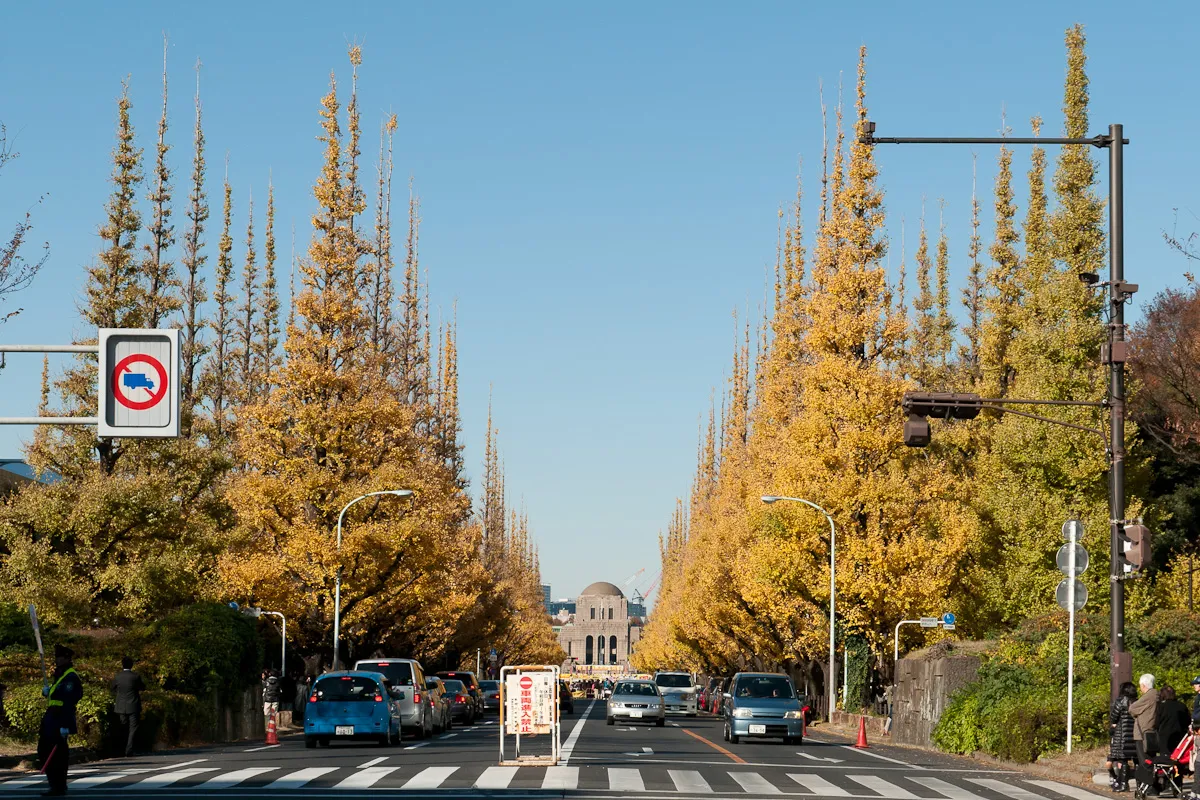
Jingu Gaien ginkgo avenue
Two rows of ginkgo trees line the avenue that leads to the Meiji Memorial Picture Gallery, and at their peak they form a golden tunnel with a carpet of leaves underneath. The Jingu Gaien Ginkgo Festival, held since 1997, sets food stalls under the trees from mid November to early December. In 2026 the Picture Gallery at the end of the avenue is under renovation, so the classic straight-down-the-avenue photo includes scaffolding; the trees themselves are untouched. Weekday mornings are the calm time. Weekend afternoons at the peak are shoulder to shoulder.
Rikugien, lit up at night
Rikugien is a daimyo garden laid out in 1695 for Yanagisawa Yoshiyasu, a stroll garden around a large pond with islands, bridges and a teahouse. In late November and early December its maples are lit up in the evening, reflected in the water, with a separate evening ticket. The exact dates are published by the Tokyo Metropolitan Park Association each autumn, and advance tickets usually mean a shorter queue. If you see only one place after dark, make it this one.
Koishikawa Korakuen and Shinjuku Gyoen
Koishikawa Korakuen is one of Tokyo's oldest gardens, from the early Edo period, with maples around its ponds and stone bridges, and it is far quieter than its fame suggests. Shinjuku Gyoen, the great national garden on the edge of Shinjuku, mixes a Japanese garden, an English landscape garden and a French formal garden, so its maples, plane trees and ginkgo turn at slightly different times and the park stays colourful for weeks. Both charge a small entry fee and close in the late afternoon, so go early.
Showa Kinen Park and Mt Takao, to the west
Showa Kinen Park in Tachikawa, about an hour west of the centre by car, has long ginkgo avenues and a Japanese garden that usually colour from mid to late November, a little before the city centre. Mt Takao, also to the west, peaks in mid to late November; it is easy to reach by train from Shinjuku and very crowded at weekends, so it is one place where we would honestly suggest the train.
An autumn afternoon by car
The city spots are close together on a map and far apart on foot, with changes between metro lines in between. By the hour, your chauffeur can take you to the Gaien avenue in the morning, Shinjuku Gyoen or Koishikawa Korakuen around midday, and Rikugien's evening lights after dark, with the car waiting at each stop and warm when you come back. It is from ¥16,500 an hour in the Toyota Alphard for up to four guests, with a minimum of four hours. Four hours, the usual autumn afternoon, is ¥66,000, tolls and parking included.
If you want the mountains too
For colour on a bigger scale, Nikko, Hakone and Lake Kawaguchiko with Mt Fuji are each a full day from Tokyo, and they peak earlier than the city. Our autumn leaves near Tokyo guide follows the colour week by week.
Frequently asked questions
When do the autumn leaves peak in Tokyo in 2026?
Forecasts published in September put Tokyo's ginkgo at its best around 26 November and the red maples around 29 November. The city season runs from about mid November to early December.
Where is the best place to see autumn leaves in central Tokyo?
The Jingu Gaien ginkgo avenue for gold, Rikugien for maples lit up at night, and Shinjuku Gyoen and Koishikawa Korakuen for quieter gardens.
Is the Jingu Gaien ginkgo avenue different in 2026?
The trees are the same, but the Memorial Picture Gallery at the end of the avenue is under renovation, so scaffolding appears in the classic photo.
Do I need tickets for the Rikugien illumination?
Yes, the evening illumination has its own ticket, separate from daytime entry. Dates and tickets are announced each autumn by the Tokyo Metropolitan Park Association.
How much is a private autumn leaves tour in Tokyo?
By the hour, from ¥16,500 an hour with a four hour minimum. A four hour autumn afternoon is ¥66,000 for the whole car, up to four guests.